MoreExam
1. Question Content...
EXPLANATION
Answer: X - EXPLANATION Content.
Question1: An installer troubleshooting a ground-mounted array finds It to be performing as expected most of the time, but a ground-fault error is indicated on hot days. The inverter is in a shaded location. Which of the following should theinstaller check for FIRST when troubleshooting this array?
Question2: An installer has decided to use 31 in. long. 3.1/2 in diameter conical ground screws as the footings for a3.840W solar electric system. Access to he is too difficult to pour concrete footings. The soll is classified as sandy loam. The design wind speed is 90 mph with an uplift force of 32 ibs/ft2. What is the MINIMUM number of screw required to resist uplift loads?
Question3: Which of the following requires a UL listing or its equivalent?
Question4: A site has a known magnetic declination of 14 west. What should the corrected azimuth reading of the array be in order to be facing true south?
Question5: The following dc portion of a PV schematic (functionally grounded conductor not shown) is submitted to the building official for permit approval. The building official, who also is he AHJ, allow the system to be installed by requiring what NEC-required MINIMUM size equipment grounding conductor at Location A?
Question6: A PV system installation utilizes micro inverters connected to each module of the array. Each micro inverter has a nominal rated output of 250WV. Single phase. The microinverters are listed so that multiple inverters may be connected in parallel to a single feeder circuit, and each inverter has ancable and connector rated for30A. What is the MAXIMUM number of inverters that may be wired together on a single 30A feeder circuit?
Question7: An installer was asked to provide a means to measure the voltage of each battery in a system. The bank is located 50 ft.From the data logger. The installer will be using shielded. Twisted pairs of instrumentation wiring, all run in the bundle a conduct.The signals are connected to isolated and ungrounded inputs at a data logger. Which safely precaution is MOST needed to protect the instrumentation wiring?
Question8: A project is using a PV module with a 25-38dc maximum power voltage range and a single input inverter with an operating windows of 250vdc-450dc. The dwelling the system is to be installed on has a 5:12 roof with a southeastem face that can accommodate 14 modules and southwestern face that can accommodate 10 modules.What is the MAXIMUM number of modules that can be installed for proper inverter maximum power point tracking?
Question9: An 8KWsc roof-mounted array is placed on a school building. The inverter is located within 1 ft, of the array boundary and has an integrated ac-and dc-disconnecting switch. The system is to be connected to a 400A load center, protected by a 400A main breaker. Which of the following MUST be included to meet NEC requirements?
Question10: An installer is using 1/2 in lag boits to secure roof-monitoring hardware to rafters through a roof deck. Which of the following should the installer predrill?
Question11: Which of the following is an NEC-indicate means to identify PV source and output circuits at accessible points of termination connection, and splices?
Question12: A homeowner is concerned that a 6kWdc PV system might be experiencing a performance issue. The homeowner has noticed what appears to be declining production. The installer analyzes the following data acquisition system (DAS) results for each year since the installation:Given the data, which is the MOST likely conclusion to draw?
Question13: A grid-interactive PV system with battery backup is being installed with a ground-mounted PV array located200 ft, from the inverter and batteries. The dc PV output circuit has overcuit has overcurrent protection rated from 30A. To reduce voltage drop between the array and batteries, the output circuit wire size was determined to be 6 AWG. The fused dc disconnect between the inverted and batteries is rated for 300A. What is the required size of the equipment grounding conductor between the metal battery case and the inverter?
Question14: Insulation resistance testing is being performed on the conductors of a 3-year-old PV system. With a constant high test voltage being applied to a dc conductor, the test results in a high resistance reading. Which does this finding indicate?
Question15: Most electric service providers require interactive PV equipment to comply with which for interconnection to their distribution grid?
Question16: A AWG THWN-2 PV output conductors from two PV arrays are run in the same 3 in, conduit to their respective functionally grounded inverters in the building. The three PV source circuits are each protected by a15A fuse in the combiner box at the array. The conduit, which is strapped directly to the roof,is exposed to design temperatures of 140' F (60'C) during its 30 ft.Exposed run. What is the MAXIMUM current carrying capability value of the PV output conductors?
Question17: A bank of batteries with capability of supplying 250A and a maximum voltage of 325V is housed in a concrete structure in a very humid location. There is service access alsie between rows of batteries. What is the REQUIRED safety distance between the rows of batteries.
Question18: Which circuits are on the utility side of a service point?
Question19: The NEC requires that PV systems installed on dwellings incorporate which of the following components?
Question20: A residential PV system uses two 120.240Vac utility-interactive inverters with a sealed lead-acid battery energy backup for protected loads. The MOST important protected load consideration when operating in the backup mode is that:
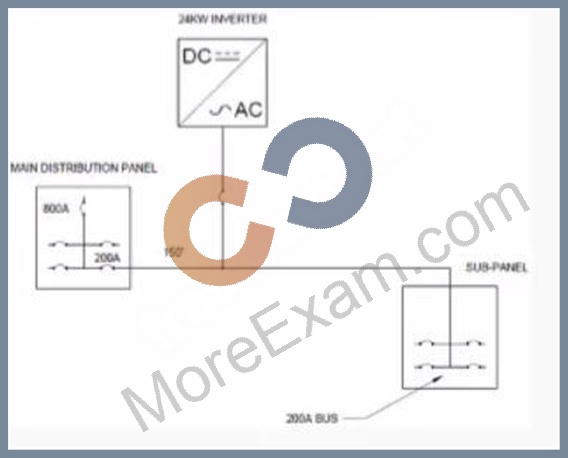
Question21: A PV connection is being made at the center of a 300 ft. long 200 feeder. See the attack diagram. The feeder originates in the upper third of the 800A main service panel (800A main breaker) with a 200A breaker and terminates in a 200A main-lug-only subpanel. The rated output of the PV system inverter is 100A.Which are the NIMUMUM actions required to achieve an NEC-compliant installation?
Question22: An 8 AWG bare copper equipment ground conductor (EGC) is wire tied to the module mounting structure of a commercial rooftop solararray. After a few years of operation, some spots on the EGC begin to turn a green color and appear to be corroding more significantly that other places. What would the MOST likely cause of the problem?
Question23: Which is a requirement for designated battery rooms?
Question24: According to the NEC, where on a residential PV system MUST the labeling describing the type of rapid shutdown be located?
Question25: Which of the following voltages should be included on the dc disconnected label to indicate MAXIMUM system voltage?